Blog

  • The Kolling welcomes Australia’s leading genomics provider to the institute

    The Kolling welcomes Australia’s leading genomics provider to the institute

    Researchers within the Kolling Institute will shortly have the chance to strengthen their genomics capabilities, with AGRF – the Australian Genome Research Facility – establishing a laboratory within the institute.

    The new lab is part of an exciting partnership between AGRF, the University of Sydney and the Kolling which will see a specialised team and cutting-edge technology located within the institute.

    As Australia’s largest provider of genomic services, AGRF supports researchers and organisations to drive discovery across clinical genomics, translational research, agriculture and environmental science.

    The Kolling’s Academic Director Professor James Elliott welcomed the collaboration saying we are proud to partner with AGRF.

    “By establishing a translational genomics facility within the Kolling Institute, we will be well placed to progress innovative research and directly improve health outcomes,” he said.

    “The partnership will not only benefit our researchers within the Kolling, but clinicians and researchers across Northern Sydney. It will help speed the translation of genomics research into patient care with direct input from clinicians and health providers.

    “The new lab will foster discovery science and a pathway to incorporate new knowledge and capabilities into clinical care.

    “We are looking forward to exploring collaborative research and educational opportunities with the leading genomics provider, and we are excited to see the advancements in care this partnership will deliver.”

    AGRF provides world-class expertise and high-quality genomic data from single-gene analysis to whole genome sequencing and biomarker discovery.

    From the time of opening, AGRF will offer its full suite of genomics and proteomics services to Kolling researchers, including project consultations, sample drop-off, high-quality sequencing, genotyping, transcriptomics, epigenomics, Olink proteomics and bioinformatics.

    These services will be backed by AGRF’s national network of specialist laboratories and technical experts.

    The on-site presence will make it easier for investigators to connect directly with AGRF’s team for project planning, study design and genomics research support.

    All services provided through AGRF’s national network can be accessed via the Kolling site, with sample drop-off and project co-ordination available.

    AGRF’s team will work closely with Kolling researchers to identify future opportunities for expanded workflows, pilot projects, and new technology implementations.

    Head of Strategic Business Desley Pitcher said we are thrilled to be joining the Kolling Institute community.

    “Our mission has always been to power discovery through genomics, and we look forward to partnering with Kolling researchers to bring that to life,” she said.  

    If you would like to know more, contact Oliver Distler – AGRF Senior Account Manager oliver.distler@agrf.org.au

  • New study tests how stress and big meals can trigger a heart attack

    New study tests how stress and big meals can trigger a heart attack

    A heavy Christmas lunch, an argument or even smoke from a bushfire may seem harmless, but for people at risk of heart disease, they could be deadly.

    A new study is investigating how emotional stress, pollution, chest infections, and large meals can trigger heart attacks in vulnerable people, and importantly, how to manage those triggers in the moment.

    Royal North Shore Hospital cardiologist and Kolling Institute researcher Professor Geoffrey Tofler is leading the clinical trial, which is now recruiting people to test whether taking aspirin or beta blockers at the time of a trigger can help prevent cardiac events.

    During the trial, participants will use an app to log symptoms and receive stress-reduction advice.

    Professor Tofler, who has researched heart attacks for close to 40 years, says the science tells us that some heart attacks aren’t random.

    “If people are aware of the triggers, there’s something they can do about them,” he said.

    The research team is looking for 120 people over 40 to join the seven-month study dubbed the Triggered Acute Risk Prevention study or TARP. Three sites are involved in the trial including Royal North Shore Hospital, North Shore Private and Westmead Hospitals.

    Participants must have at least two risk factors for heart disease – such as high cholesterol, blood pressure, smoking or diabetes – or known heart disease.

    “If you’ve just had an argument or know you’re heading into a big meal, the app helps you act,” says Geoffrey.

    “You log the trigger, like anger or a heavy meal, and it guides you through what to do.

    “Despite all the advances in understanding about risk factors like high blood pressure and high cholesterol, and the treatments, heart attacks remain a leading cause of death,” he said.

    For further information on how to take part in this study, please email your closest site: For Royal North Shore and North Shore Private: Cheryl.Macadam@health.nsw.gov.au or Anjani.Meka@health.nsw.gov.au for Westmead Hospital.

    The study has been approved through HREC 2024/ETH02331. 

  • Kolling Institute Newsletter May 2025

    Kolling Institute Newsletter May 2025

    Check out our latest newsletter

    • Researchers target sleep for muscle pain relief
    • Landmark clinical trial to improve lung cancer treatment
    • Pioneering Muscle Map project receives funding support
    • Travel awards for emerging research leaders
    • And much more: 

    Click here:

  • Crucial new funds to help improve heart and kidney disease treatment

    Crucial new funds to help improve heart and kidney disease treatment

    Royal North Shore Hospital’s Associate Professor Brendon Neuen will establish an international consortium to support those with both heart and kidney disease.

    The nephrologist and Director of Kidney Trials will lead the collaboration after being awarded close to $500,000 from NSW Health through a program to drive groundbreaking projects in heart disease.

    The grant will support the establishment of the ROCKET Consortium, a global initiative to determine the best way to assess kidney disease progression in people with heart failure.

    The collaboration will bring together the team at Royal North Shore Hospital with world leading experts at Harvard Medical School and Tufts Medical Center in Boston, and the University of Groningen in the Netherlands.

    The project will analyse data from 12 landmark heart failure trials involving more than 50,000 patients to confirm the best approach to track the loss of kidney function in heart failure trials.

    As researcher with the Kolling and The George Institute, Associate Professor Neuen said their work has the potential to shape how future clinical trials are designed for those with heart and kidney disease, and improve outcomes for people with both conditions.

    “Nearly half of those with heart failure also have chronic kidney disease, which means they generally do worse overall and are admitted to hospital more often,” he said.

    “However, without a standard method of measuring loss of kidney function in heart failure trials, we are potentially missing opportunities to identify treatments which could protect the heart and kidneys.”

    He says the international team is excited by the broad interest in their work to date.

    “Our research is already drawing attention from the U.S. Food and Drug Administration as it has the potential to inform regulatory standards and the development of new medications for both heart failure treatments and kidney disease.

    “With a large share of the community living with heart and kidney disease, we are hopeful our work will improve the long-term health and wellbeing of people affected by both conditions.”

  • Kolling Research Symposium 2024

    Kolling Research Symposium 2024

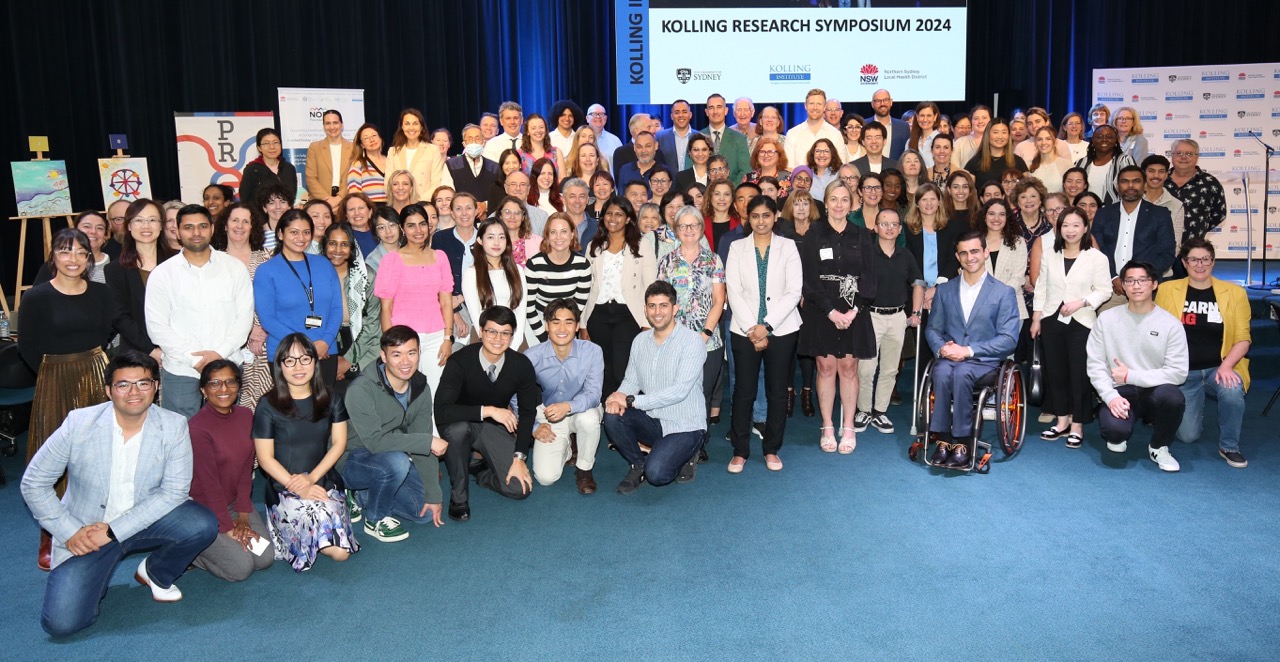
    We would like to thank everyone involved in the 2024 Kolling Institute Symposium.

    During the event, a diverse collection of researchers detailed the latest progress with their ground-breaking work into kidney and heart disease treatments, bone and muscle conditions, rare cancers, and neurological challenges. There was a focus too on the innovative work to develop a unique wellbeing index.

    Researchers discussed how they’re tapping into technology to deliver care to large numbers of patients, improving outcomes with the latest heart valve devices and investigating the benefits of reducing multiple medications for older patients.

    The symposium brought together researchers, representatives from our joint venture partners (Northern Sydney Local Health District and the University of Sydney) and a growing network of community partners to celebrate our impactful work.

    Academic Director Professor James Elliott said the event featured thoughtful presentations, panel discussions, poster presentations, and an Oxford Debate on the impact of AI on healthcare. 

    “I would like to thank our guest speakers Professor Susan Morton, Director of INSIGHT at the University of Technology and Lifeline Australia ambassador and wellbeing advocate Matt Caruana who shared his personal experience and inspiring perspective,” he said.

    “The symposium provided an opportunity to hear how our researchers are extending our understanding of complex conditions and improving therapies and outcomes.  

    “It also offered the chance to highlight some special awards for a group committed to increasing access to high-quality care, and improving the health and wellbeing of our broader community.

    “I would like to congratulate the 2024 Kolling Institute award recipients for their remarkable commitment to our research success.” They include:

    PhD Supervision Award
    Associate Professor Sonia Saad
    Department of Medicine, Renal Research Laboratory

    HDR Student Award
    Amanda Purcell
    Renal Research Laboratory

    Discovery Science Award Category A
    Dr Nunki Hassan
    Cancer Stem Cell and Biology Laboratory

    Discovery Science Award Category B
    Dr Sumit Sahni
    Bill Walsh Translational Cancer Research Laboratory

    Professional Staff Award Category A
    Susan Smith
    Raymond Purves Bone and Joint Research Laboratory
    Kolling Histology Core Facility

    Professional Staff Award Category B
    Annette McCook
    Research Development Officer 

    Excellence in poster presentation
    Claire Wong

    Excellence in oral presentation 
    Dr Karan Rao

    “Thank you to the many people involved in bringing this large-scale event together to highlight the remarkable and life changing work underway at the Kolling Institute,” said Professor Elliott.

  • Kolling NEWS

    Kolling NEWS

    Our Kolling Institute newsletter brings together a collection of profiles on our impressive researchers. Flip through our flipping book to discover more about our leading research into kidney disease, rare cancers and the use of supplements for osteoarthritis. There’s a focus too on the first steps towards gene therapy for Meniere’s disease, the latest research into treatments for dementia and an innovative program taking musculoskeletal care to the bush.

  • Innovation at the Kolling’s core

    Innovation at the Kolling’s core

    In the heart of the Kolling Institute, a world-renowned research centre, a raft of clinical trials is driving the future of healthcare.

    “Clinical trials are intrinsic to research,” says Professor James Elliott, Academic Director of the institute. “They help us test something so that we can better inform care for patients with various conditions who come to our hospitals for treatment.”

    The Kolling Institute has a strong track record in conducting impactful clinical trials. Notably, it has been involved in running multiple trials for those with heart and kidney disease, musculoskeletal conditions and chronic pain.

    Their cancer trials have made significant contributions across various tumour streams, including pancreatic, haematological, breast, and bowel cancers.

    James emphasises that basic science, discovery and scientific innovation are embedded in the Kolling’s over 100-year history.

    “Often, it is those innovations from our basic science laboratories that ultimately inform the mechanisms by which trials are developed.”

    James adds that understanding the ways diseases work allows researchers to target trials more precisely, leading to better patient outcomes.

    However, the need for trials sometimes outpaces scientific understanding.

    “We can’t always wait for a full understanding of a disease,” James notes. “In some cases, we must move forward with trials to push the needle on patient care, even as we continue to explore the underlying mechanisms.”

    A key advantage for the institute is its proximity to one of Australia’s largest tertiary hospitals, Royal North Shore Hospital. This connection provides access to a vast patient population, which is crucial for conducting large-scale clinical trials.

    “We serve over a million patients,” says James, stressing the importance of their “trial as therapy” culture. “We want patients to expect that they may be invited to participate in a clinical trial or research study as part of their care.”

    The Kolling Institute is a world leader in researching osteoarthritis, musculoskeletal conditions, cancer, neuroscience and pain, and cardiac, cardiovascular and renal disorders. 

  • Researchers develop urine test based on kidney cell colour and AI to diagnose chronic kidney disease

    Researchers develop urine test based on kidney cell colour and AI to diagnose chronic kidney disease

    We may soon have a convenient and painless approach to diagnose chronic kidney disease following research by the team from the Kolling Institute’s Renal Research Laboratory.

    Chronic kidney disease is an emerging global health issue, currently affecting more than 11 per cent of Australians and 13 per cent of the worldwide population. By 2032, it’s estimated up to 125 million people will have the condition.

    Chronic kidney disease is a progressive disease which eventually leads to kidney failure. It is fatal without dialysis or a kidney transplant.

    Currently, a kidney biopsy is required to confirm a diagnosis, but this procedure brings inherent risks such as bleeding and pain. A non-invasive approach to diagnose chronic kidney disease is critically needed.

    There are some blood and urine tests available which can detect advanced stages of the disease, but early detection through these means remains challenging.

    Researchers from the Kolling Institute and the Australian Centre of Excellence for Nanoscale Biophotonics at the University of New South Wales have developed and continue to improve a urine test which provides accurate information for early diagnosis.

    This novel test is based on assessing colour properties of kidney cells exfoliated from the kidney into urine. An individual’s disease status is determined by observing colour patterns with artificial intelligence-based analysis.

    Encouragingly, this exciting new technology avoids the risk of an invasive biopsy procedure.

    Head of the Kolling’s Renal Research Laboratory Professor Carol Pollock said this approach provides clear information about kidney pathology by examining kidney cells in urine through a “liquid biopsy”.

    “Having the ability to diagnose chronic kidney disease with a simple urine test represents a major step forward,” she said.

    “It means patients with chronic kidney disease or those who have a high risk of disease can receive timely management.”

    Project co-lead Associate Professor Sonia Saad said the non-invasive test would also provide information on the effectiveness of drugs and other treatments over time.

    “We look forward to applying our test for wider use within the nephrology setting, such as monitoring complications in patients who receive a kidney transplant.”

    PhD student Dr Henry Wu welcomed the chance to apply artificial intelligence to their research.

    “It’s been rewarding to help develop this important diagnostic test and progress the use of AI within the nephrology field.” 

  • Special Research Feature – Year in Review 2023

    Special Research Feature – Year in Review 2023

    Our Kolling Institute Year in Review profiles our innovative and life-changing research across the Kolling Institute.

    Our researchers are driving investigations into some of the most challenging health conditions from heart and kidney disease to musculoskeletal conditions, chronic pain, cancer and neurodegenerative disorders.

    Our teams have continued to increase their research impact, while forging significant new collaborations. They have maintained a commitment to research excellence, while securing large-scale funding, receiving high profile awards and publishing impactful studies.

    We hope this feature will give you a better insight into our impressive and unique teams, and their ground-breaking research. We would like to extend our thanks to our many wonderful donors who help us deliver real improvements to the care we all receive. Click here to read the feature:

  • Tapping into our expertise to solve an escalating health challenge

    Tapping into our expertise to solve an escalating health challenge

    A culture of collaboration is a key part of the Kolling Institute’s research impact, and just one example of this is a joint project to reduce the devastating impact of vascular disease linked to diabetes.

    The study has brought together research experts from endocrinology and cardiology to curb the number of lower limb amputations due to peripheral arterial disease.

    Alarmingly, an estimated eight people a day have a lower limb removed because of the disease.

    This trend is expected to continue with an increasing number of people developing diabetes and subsequently a diabetic foot ulcer. It’s estimated more than 530 million people across the globe are living with diabetes.

    Our researchers have launched a study investigating the use of medications to treat diabetic foot ulcers and peripheral arterial disease.

    Mirabegron is one of those medications being tested. It is currently used to treat overactive bladder syndrome, but this research is helping to determine if it could restore dysfunctional blood vessels, improve oxygen and nutrients in the tissue, and help chronic wounds.

    Researcher Cameron Evans, from the Cardiovascular Discovery Group, said Mirabegron works by opening blood vessels and increasing levels of nitric oxide, one of the body’s natural antioxidants.

    “This will help blood vessels and diabetic tissue function normally and heal ulcers,” he said.

    “Importantly, we are testing the medication in a gel form as the concentration of drugs taken orally often isn’t high enough to provide a therapeutic effect.

    “Current treatments include a cocktail of medications or vascular surgery which are costly and carry increased risk.

    “We hope our research will confirm if this medication will reduce amputation, improve quality of life and increase life expectancy.

    “One in five people with diabetes is likely to develop an ulcer, so we could potentially be helping more than 130 million people with our research.”

    The research project has been supported by the Australian Centre for Accelerating Diabetes Innovation PhD grant.

    Cameron said he was tremendously grateful to receive the grant.

    “Working weekends and researching five days is a tough slog, so receiving the grant is an incredible help.

    “It has given me dedicated time to progress our valuable investigations.” 

NSWGOV logo