
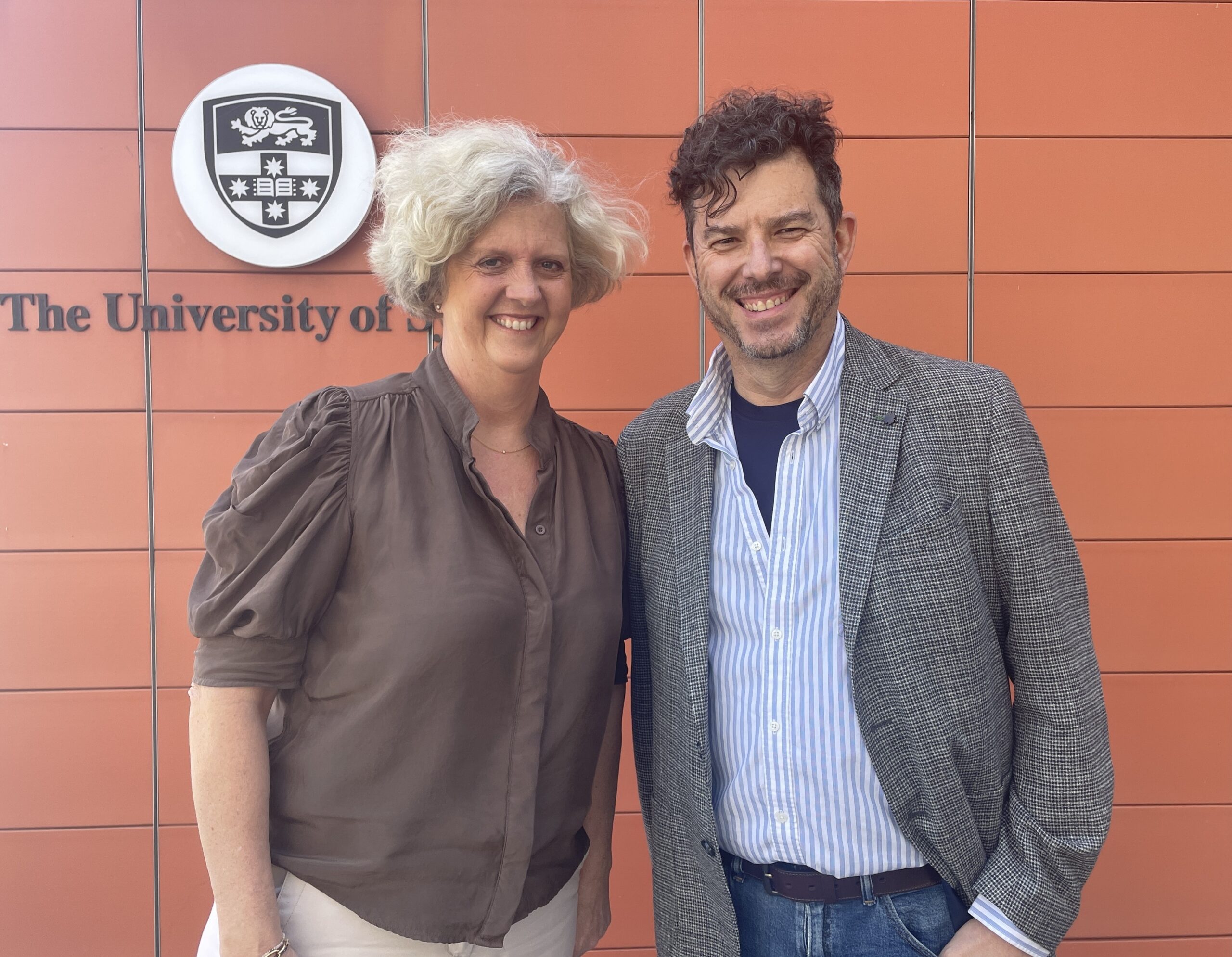
For many people living with Meniere’s disease, there’s a tremendous sense of isolation and plenty of challenges accessing the latest, accurate information – that’s why 58 year old Camilla Bjerke flew more than 15,000 kilometres to Sydney to meet with the Kolling Institute’s Professor Jose Antonio Lopez-Escamez.
The professor heads the Meniere’s Disease Neuroscience Group, a talented group of investigators working to uncover the key drivers of the disease, and develop new and effective treatments to help manage the disabling condition.
Meniere’s disease is a rare inner ear disorder, defined by sensorineural hearing loss, vertigo and roaring tinnitus.
For Camilla, who has worked as a pilot in Norway for more than 30 years, her diagnosis was devastating.
“For me, it was twofold. I had to accept that I had this condition, with constant dizziness, vertigo and hearing loss, but also, that I would lose my medical clearance and would no longer be able to fly and continue my career,” she said.
“Being a pilot was part of my identity and such an important part of my life. I loved being able to travel all over the place, and meet a lot of people, so it really has been difficult.”
With limited information about the rare condition, Camilla turned to community Facebook groups for support and guidance. It was through these groups that she heard about Professor Lopez-Escamez and his leading research into Meniere’s disease.
Camilla reached out to the eminent academic and was invited to take part in the research program based at the Kolling Institute. She underwent genetic, hearing and targeted testing, hoping to discover more about her condition and help progress the vital research.
“I would fly anywhere to learn more about the condition,” she said.
“It’s so important to be able to speak to someone who understands, so I feel very fortunate to be able to come here and be part of this research.”
Camilla said it has been valuable to hear about the specific subgroups of the disease, information which she says is not widely known or understood.
Camilla hopes that by taking part in the research she may also be helping her family and others in the same situation.
“I wouldn’t be surprised if my condition has been inherited, so I would like to do what I can to help advance the research for my children too.”
Professor Lopez-Escamez and his team at the Kolling are pursuing world-leading investigations into the genetic factors influencing the disease and taking crucial steps towards the development of game-changing gene therapy, which is expected to revolutionise treatment for the condition over the next decade.
If you would like to support and collaborate with this research, you can donate a blood sample for genetic studies or financially support the Meniere Disease Research Program at the Kolling Institute, University of Sydney, Contact: meniereaustralia@sydney.edu.au

