
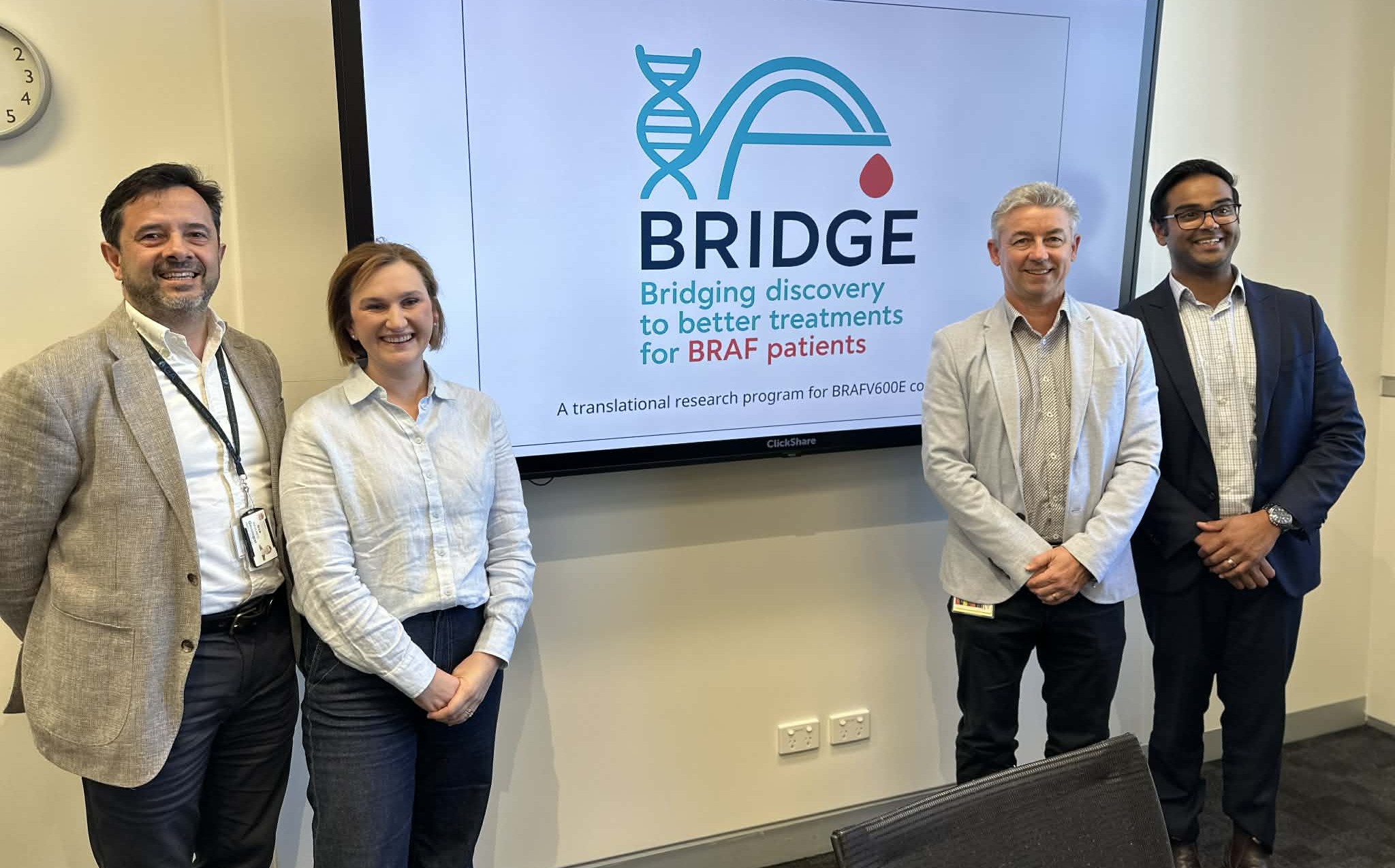
The University of Sydney and the Kolling Institute have launched a groundbreaking research program to transform treatment for one of the most aggressive forms of bowel cancer.
Supported by a $1.3 million philanthropic gift, the BRIDGE program offers new hope for patients with BRAFv600e‑mutated bowel cancer.
This mutation, present in around 10 per cent of colorectal cancer cases, drives tumour growth and is associated with significantly poorer outcomes. While two targeted therapies – encorafenib and cetuximab – have been approved, many patients quickly develop resistance, leaving a critical gap in care. BRIDGE seeks to address this gap by uncovering why some patients respond well to treatment while others relapse, and by identifying new treatment strategies for relapsing disease.
Patient, Gemma Farquhar, said this donation is deeply personal.
“When I found out I had BRAF, carrying a poor prognosis, I felt like there was no future,” she said.
“Knowing treatments are likely to fail, is a terrifying place to be. Research like BRIDGE gives people like me something – time, options and hope. It means scientists are looking ahead now, for the future.”
Lead researcher Professor Mark Molloy said many patients feel they are running out of options. “Our work is dedicated to changing that,” he said.
BRIDGE is the first clinical study of its kind for BRAF‑mutated bowel cancer, using precision medicine approaches such as liquid biopsies to analyse tumour DNA from blood samples and track treatment response over time.
Co‑lead investigator Professor Nick Pavlakis said advances in genomic technologies are opening new possibilities. “Liquid biopsies allow us to understand which treatments are most likely to benefit each patient,” he said. “It’s about matching the right treatment to the right patient at the right time.”
The program will also explore the tumour’s immune environment, an area that remains largely unexplored in BRAF‑driven bowel cancers. By identifying immune cells within tumours and linking them to treatment outcomes, researchers hope to better understand why responses vary so widely.
In parallel, the team will grow patient‑derived tumour samples in the laboratory, creating organoids that closely mimic the cancer. These models will enable researchers to safely test potential drug combinations before they are considered for clinical use.
Professor Molloy said BRIDGE represents a rare and powerful opportunity for translational research. “By combining laboratory science with clinical expertise, our findings can move quickly from the lab to benefit patients,” he said. “The program will also support and train the next generation of cancer researchers, strengthening a field that has historically received limited funding.”
Ultimately, BRIDGE aims to deliver both immediate insights and long‑term breakthroughs – identifying the genetic and immune factors that drive treatment response, uncovering vulnerabilities in resistant tumours and providing renewed hope for patients with BRAF‑mutated bowel cancer.

